


I always struggled to identify whether I was a specialist or a generalist.
During my studies, I narrowed my focus at every step. I studied maths, physics, and chemistry at A level, then maths and physics during my undergrad, and finally physics during my PhD. And the PhD wasn't in all of physics. It was in optics, and specifically in a narrow field within optics. I then spent over a decade working in this specialised field.
That settles it, then.
But was I a true specialist? I got quite good at the branch of optics I needed for my work, but others around me were better. I got reasonably proficient with coding to model physical processes and analyse data, but I had plenty of gaps in my programming knowledge. I quickly learnt how to become an effective lecturer and communicate with students as I designed and delivered undergraduate courses. Being an expert in a subject doesn't automatically make you good at teaching it.
When I left academia and started teaching Python, I wasn't an expert programmer and I was relatively new to Python. Sure, I got a lot better relatively quickly. But my strength was in teaching and communication, not in my programming expertise.
To run my business, I had to know or learn a bit of lots of stuff: accounting, marketing, sales, customer service, and managing staff. But I lacked a lot in all of these areas, too.
I'm a scientist by training and a technical educator by profession. But I enjoy languages, history, geography, sports, economics. The list goes on. I like to know stuff about any topic.
Perhaps I am a generalist and I've always been, even though I thought I was a specialist. Maybe it's time to embrace my generalist nature.
In the last few months, I've found a good reason to do just that. AI is helping me do more with knowledge and skills I already had, in several different fields. Things I knew something about, but not enough to carry through on my own, are becoming things I can actually do.
And I'm loving it.
Generalist vs Specialist in the Before AI Era
The debate is not new. We need people who know a lot about a narrow field, and we need people who know enough about several fields to connect them and put that knowledge to use.
Knowledge in fields such as science and medicine has expanded so much that it's impossible to master a field without dedicating large amounts of time and effort to it. There's good reason for specialisation.
But depth takes time. And time spent going deeper into one field is time you can't spend learning about another.
That's not a criticism. It's a constraint.
A generalist makes a different trade-off. They have a broader base, but they run into the limits of their knowledge in more places. Knowing something about marketing isn't the same as being able to put together an effective marketing campaign. Understanding programming doesn't mean you're equally comfortable building every kind of software.
You can learn more, of course. Or work with someone who has the expertise you lack. But both require resources, whether that's time, money, or access to the right people.
So you can have interests, ideas, and useful knowledge that you never quite manage to turn into anything.
AI is changing that.
Generalists and Specialists During the Transition
To get from Before AI to After AI, we need to go through a transition. A period when things change. And boy oh boy we're in turbulent, changing, uncertain, unstable times right now.
When the situation changes and what worked yesterday no longer works today, it helps to have more than one way forward. A generalist has a large toolbox and more possibilities for using the tools differently. They're typically also more used to making connections across different fields.
A specialist often sees things through the lens of their speciality, and their skillset is optimised to go deeper and further within their speciality. Change can be challenging.
That doesn't mean specialists can't adapt. And being interested in lots of things doesn't automatically make you good at dealing with change.
But having several useful starting points gives you options. AI makes some of those options easier to act on.
That's the part I find most exciting. Not just having somewhere else to turn when one kind of work changes, but being able to do more in areas I already care about.
Generalist vs Specialist in the After AI Era
Before we go further, let's tear down a simplification I've been using in this post so far.
No one is really just a specialist or a generalist.
A pure specialist could be represented by this:
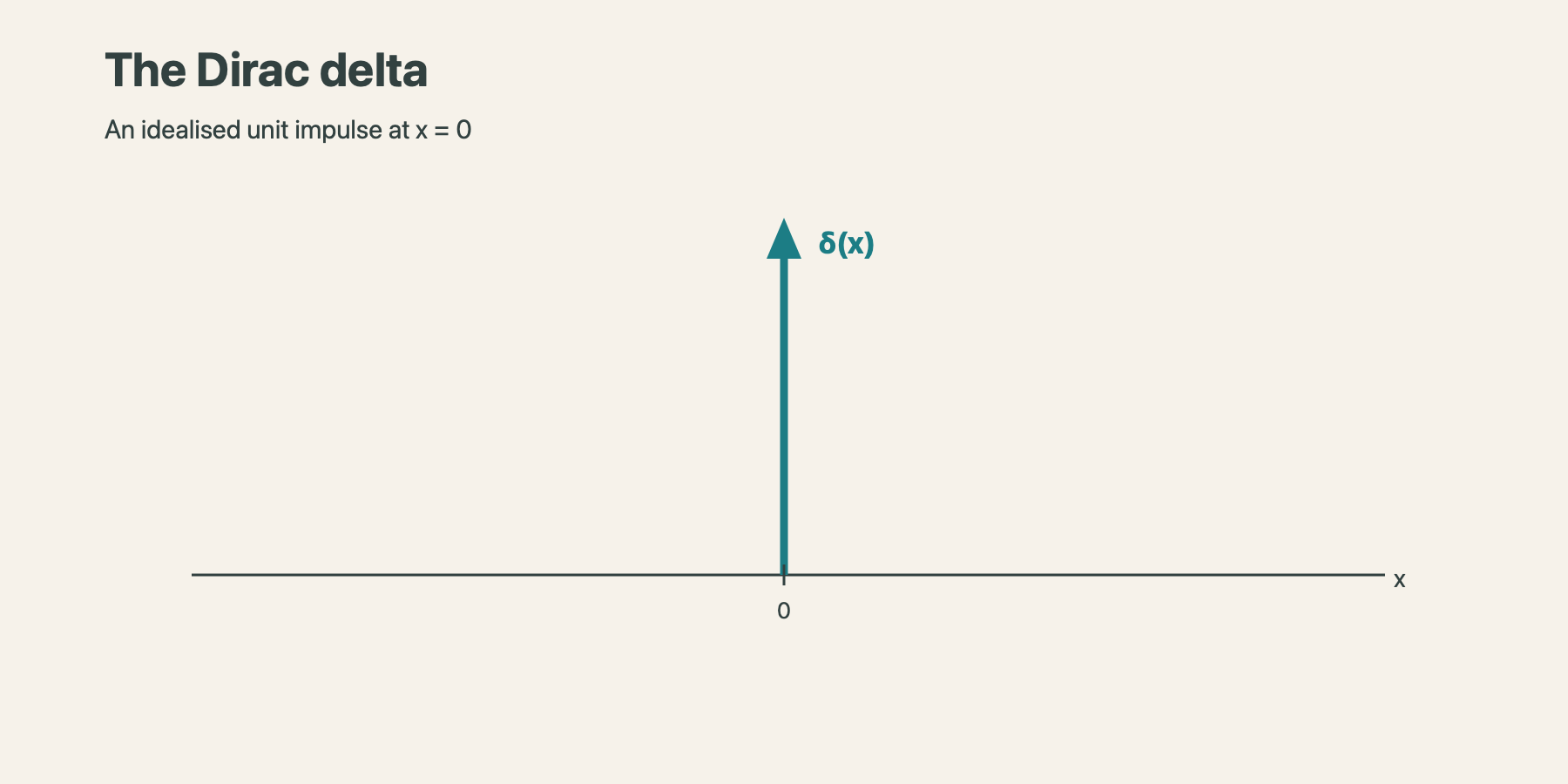
Don't worry about the maths-y bits there if you're not familiar with delta functions. An "ideal" specialist, or a 100% specialist, has expertise in one narrow topic and no knowledge of anything else. A generalist could look like this:
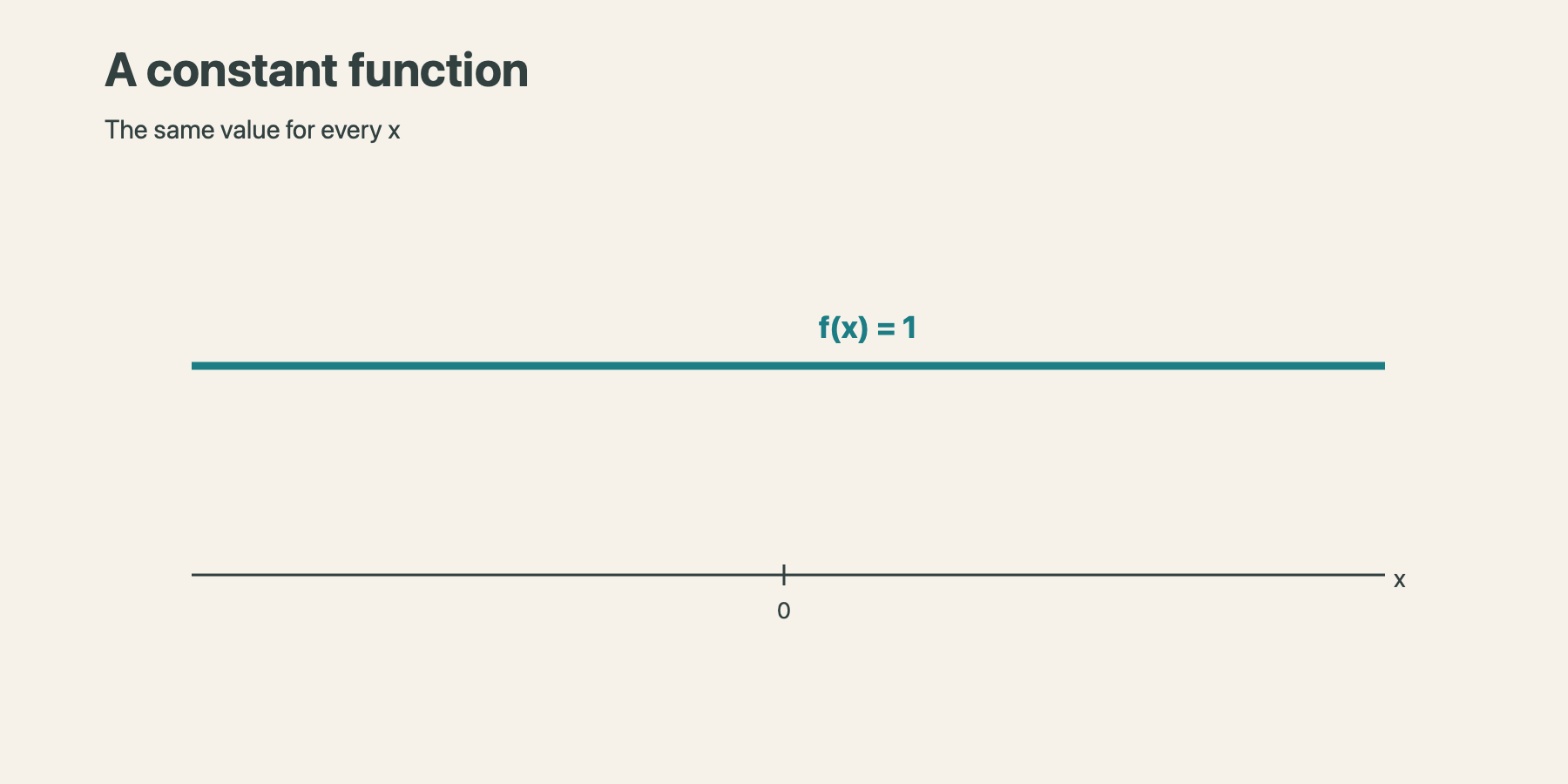
The 100% generalist has a constant amount of knowledge about everything.
You can tell I'm a physicist by nature. Physicists love to start from idealised assumptions. You've probably heard the “let's assume we have a spherical cow” joke.
A person who knows everything about one narrow topic and absolutely nothing about anything else would be a useful starting point for a model. But not a person you'll ever meet.
And a generalist doesn't know exactly the same amount about every topic, either.
There aren't any 100% specialists or 100% generalists.
Here's a typical sketch comparing specialists and generalists. The bars represent different skill areas, and their heights represent depth of expertise:
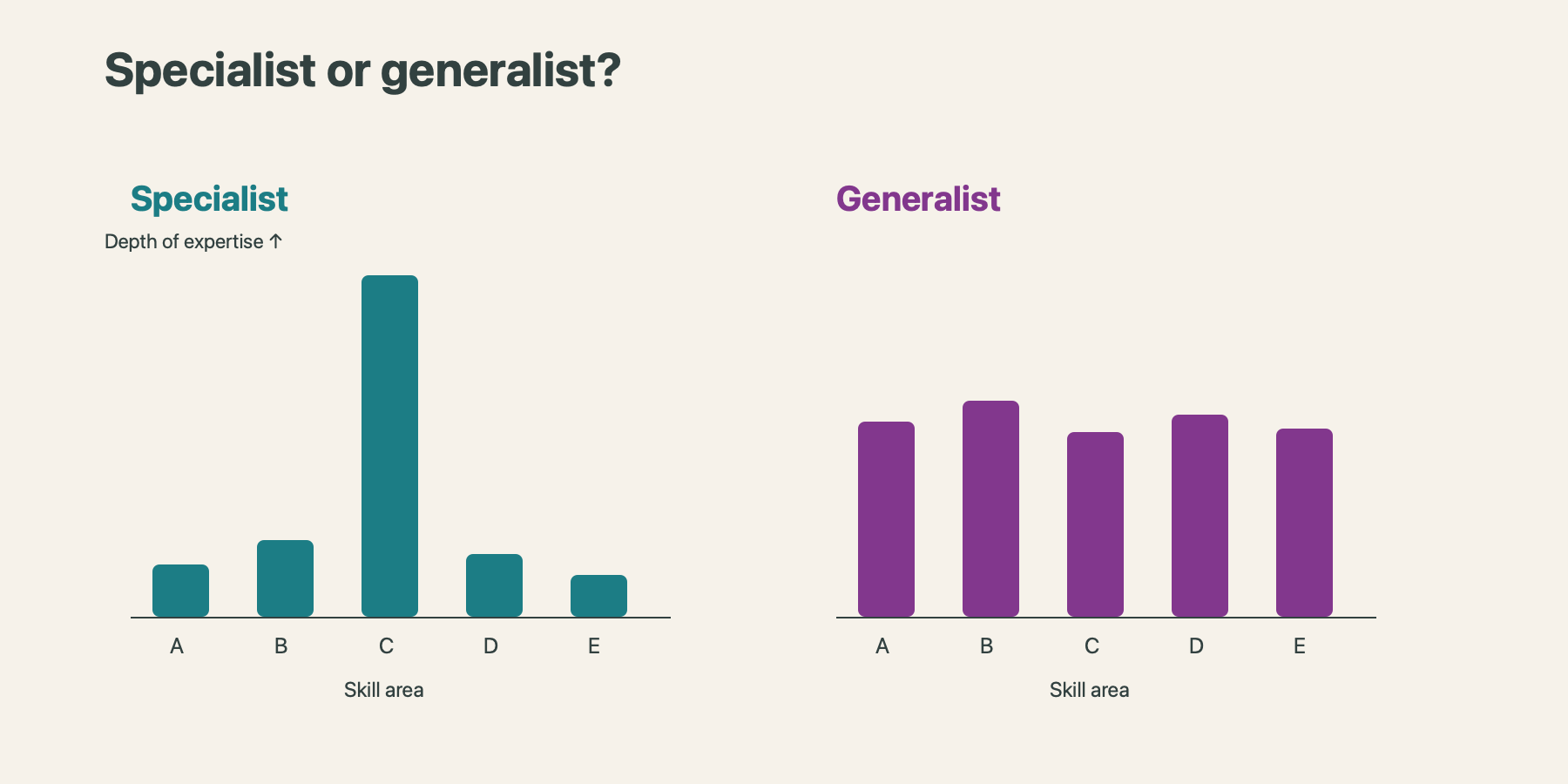
But there's an infinite number of variants. Some people have two or more high bars among the low ones. Others have a speciality but a good generalist level across many other skills. And not all generalists are the same. Some can have high bars across the board, even if not a single bar is at specialist level.
You don't have to choose between depth and breadth as though you can only have one. You can have both, in different proportions and in different fields.
So, rather than asking which of two boxes a person belongs in, we can look at the shape of their knowledge and skills. The labels are shorthand. The profile is more interesting.
AI helps fill gaps where you're not an expert. But I think the best use of AI is when a person and an AI agent collaborate (and I'm writing about this in a future post, so stay tuned), rather than when the agent just gets an instruction and works without input from the human.
If you know something about a topic, you can bring more to that collaboration. You have a better idea of what you want, you can ask more useful questions, and you have some basis for questioning the answers.
Let me give you a personal example that has nothing to do with programming.
From coaching theory to a training programme
I'm a newly qualified athletics (track and field) coach. I have plenty of theoretical knowledge, because I've been interested in this field for a long time, but limited coaching experience.
I worked with my AI agent to create a full training programme for myself. I didn't ask it to choose everything for me. I knew the philosophy I wanted to follow: build speed first, with a focus on sprinting form (running technique), then extend to speed endurance.
The focus on form mattered to me. I wanted to prioritise maintaining it, even if that meant delaying speed endurance. I also had views on how to organise the training programme across various phases.
AI helped me translate that direction into individual sessions, including the details of how the different exercises should fit together. It helped me plan the progression across the season and balance the different training demands.
I brought knowledge and priorities. AI helped me work through the detail needed to turn them into a programme.
Does that make me an experienced specialist coach? No. Creating a programme isn't the same as gaining years of experience coaching athletes, observing how they respond, and adjusting what you do.
But I could put more of what I knew into practice than I could have done alone. And I learnt more about the details of season and session planning along the way.
That's the opportunity I'm talking about.
More than one place to start
The same opportunity exists in other fields where I have some knowledge but lack the skills or experience to do everything I'd like to do. But it's not limited just to those fields. AI also helps me take some of my strongest skills further.
In some areas, it helps me bridge gaps in expertise. In others, it helps me carry through ideas I wouldn't otherwise have the time or resources to pursue.
I'll share more about some of the work my AI agent and I have been doing recently, spanning many of my strong and not-so-strong skills, in the bonus section at the end of this post.
Sometimes, several of those skills come together in one project. But they don't have to. My coaching knowledge is useful when I'm planning athletics training, whether or not I use my programming or writing skills alongside it.
A broad base gives me several places where I can work with AI to take things further. Here's a sketch of what that could look like:
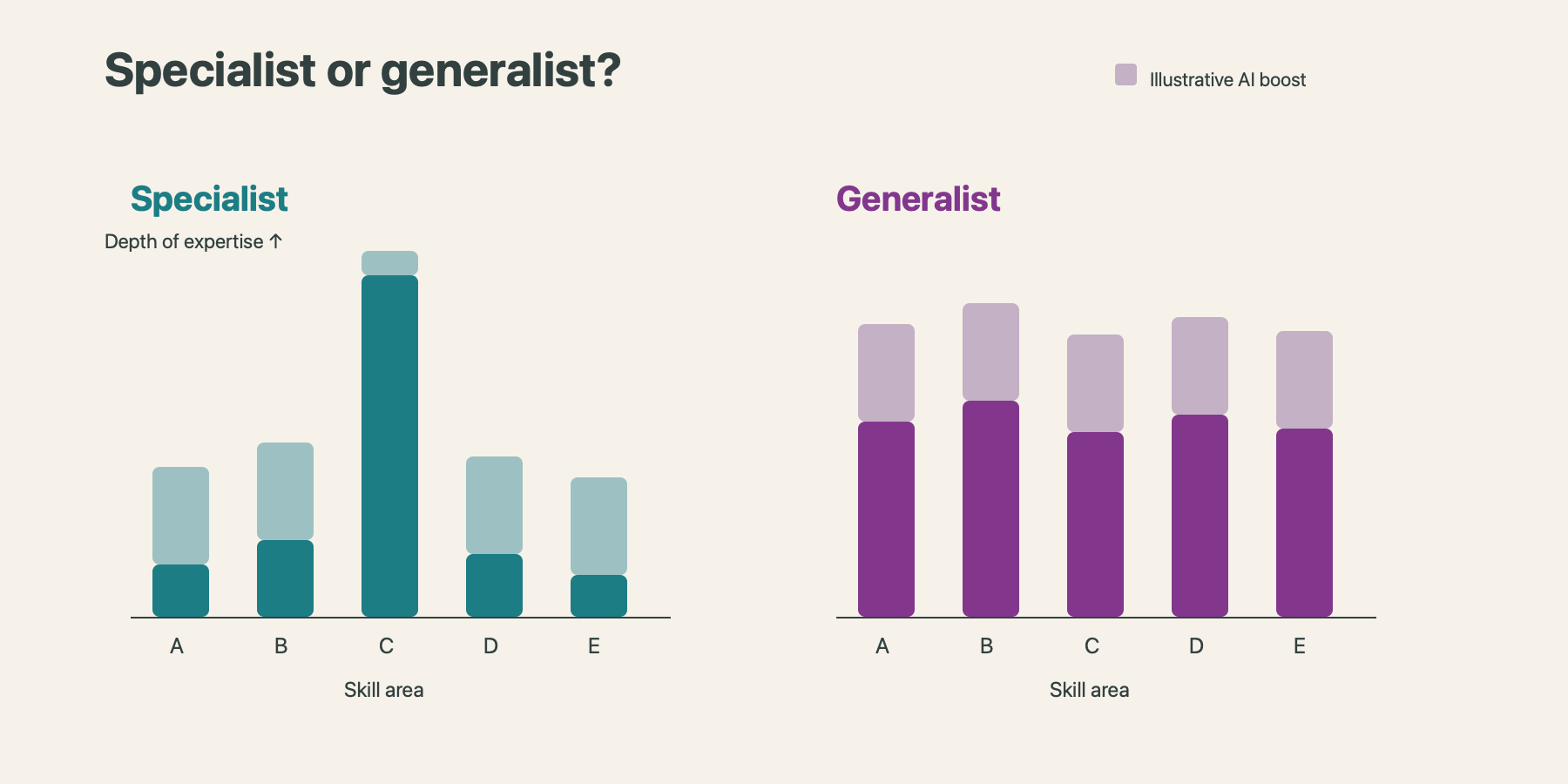
The lighter parts represent what working with AI might add to what a person can do. They're not extra years of experience magically appearing.
Nor should we read the drawing as a promise that AI adds the same amount in every field or for every person. It's a simple illustration of the opportunity. The specialist can benefit, too. The generalist has several areas with a useful foundation to build on.
And the starting point matters. Knowing nothing about a subject doesn't stop you from using AI. It can help you learn. But that's different from using knowledge you already have to direct the work and question what comes back.
Nor does knowing a little guarantee you'll spot every mistake. AI can be wrong, and so can I. The need to check the work doesn't disappear because we produced something impressive together.
My first post in the Agent & Co. section pokes fun at this idea:
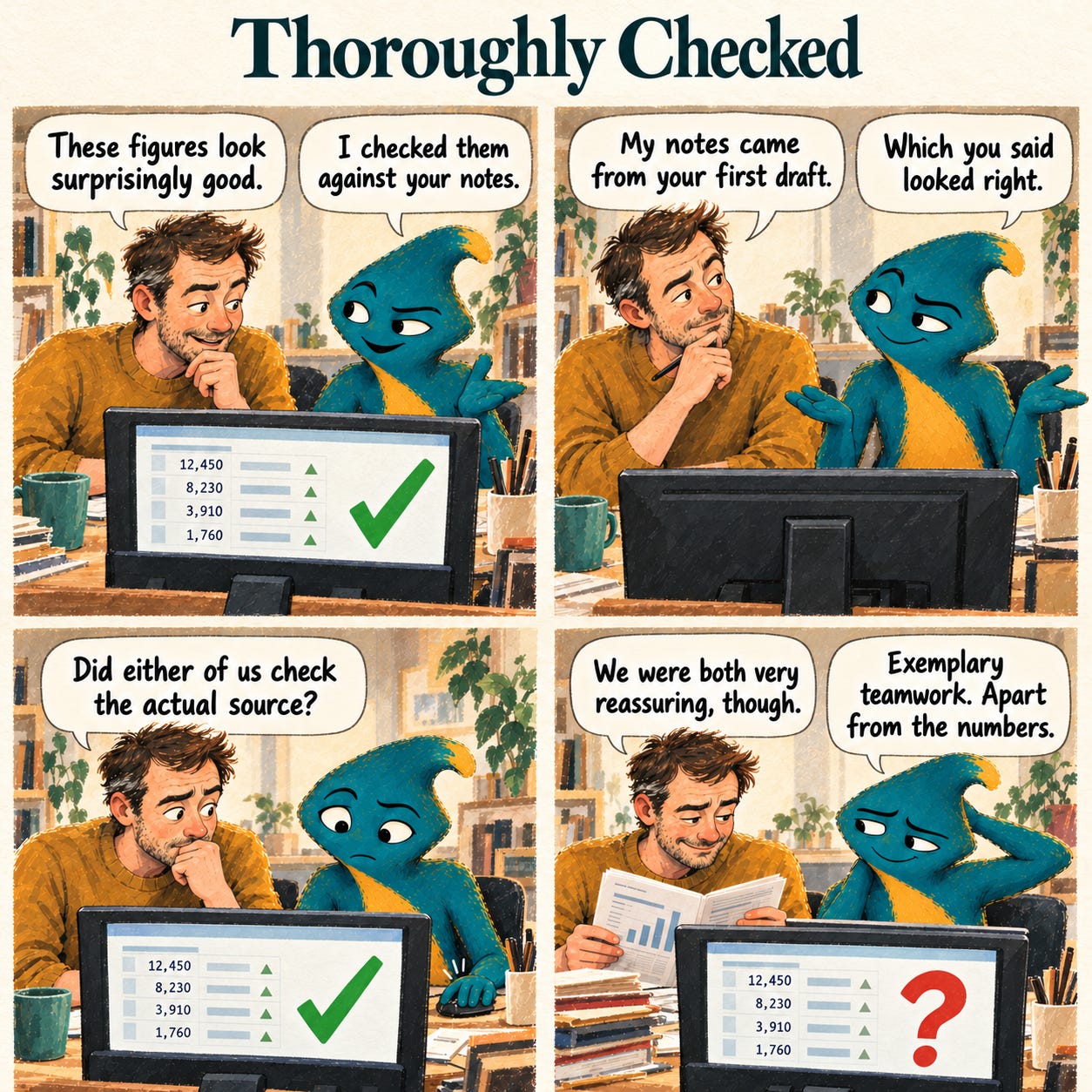
Still, the gap between “I know something about this” and “I can do something useful with it” is becoming easier to cross.
So, Is This the Age of the Generalist?
AAI, After AI, is the Age of the Generalist. I think so. But not because specialists are doomed.
Specialists can use AI to go further in their own fields, and to explore others. Deep knowledge still matters. My years in physics didn't become worthless when I started teaching Python, and they haven't become worthless now that I work with AI. They help shape how I think and how I approach problem-solving.
What excites me is that breadth can now take me further, too.
Before, I could look at some of my interests and see mostly what I lacked. I knew a bit, but there was a lot more I'd need to learn before I could do what I wanted.
There still is plenty to learn. But I don't always have to fill every gap myself before I can get started.
A generalist with strong skills across several fields has several opportunities to do more with those skills. In some tasks, working with AI may bring the result closer to what previously required specialist help. That doesn't mean the person has become a specialist in all those fields.
But it does change what's possible.
And AI can also help the generalist with bespoke learning to push those skills further.
Perhaps being interested in lots of things wasn't such a distraction after all.
Bonus: How I'm Enjoying Being a Generalist in This AAI Era
I always liked the idea of being a specialist. That's probably what led me to scientific research in my first career. But over the years, I gradually realised I like lots of things and I'm not too bad at several of them.
I didn't realise until recently that I'm more of a generalist than a specialist.
That's a shame, because I could have capitalised more on my strengths as a generalist, perhaps. But never mind, because in the last few months, I got it.
Here are a few places where I've been putting that breadth to use. Not just what I asked AI to do, but what I brought to the work and how we worked through it together.
These aren't examples of handing over a task and coming back when it's finished. The conversation is part of the work.
The bonus section is exclusively available to premium subscribers.